
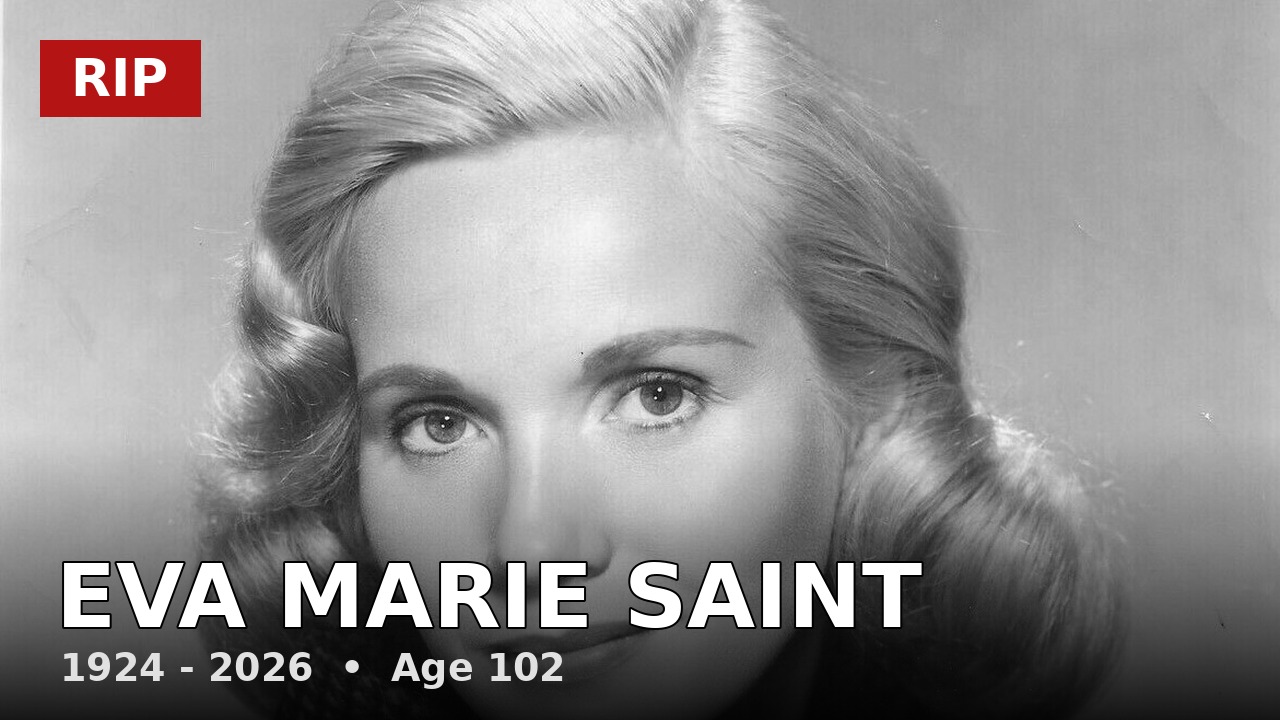
Hollywood has lost one of its last golden-era legends. Eva Marie Saint, the Oscar-winning actress who starred opposite Marlon Brando in On the Waterfront and Cary Grant in Alfred Hitchcock’s North by Northwest, has died at the age of 102.
Saint died Tuesday, October 6, 2026, of natural causes at her home in Los Angeles, surrounded by family and loved ones, her publicist Jeff Sanderson confirmed.
Born on the Fourth of July, 1924, in Newark, New Jersey, Saint began her career in live television in New York before studying Method acting at the famed Actors Studio under Lee Strasberg — alongside classmates like Brando, Paul Newman and Montgomery Clift.
Her very first film role earned her the Academy Award for Best Supporting Actress: the virtuous Edie Doyle in Elia Kazan’s gritty 1954 drama On the Waterfront, opposite Brando. She was heavily pregnant with her son Darrell when she accepted the Oscar.
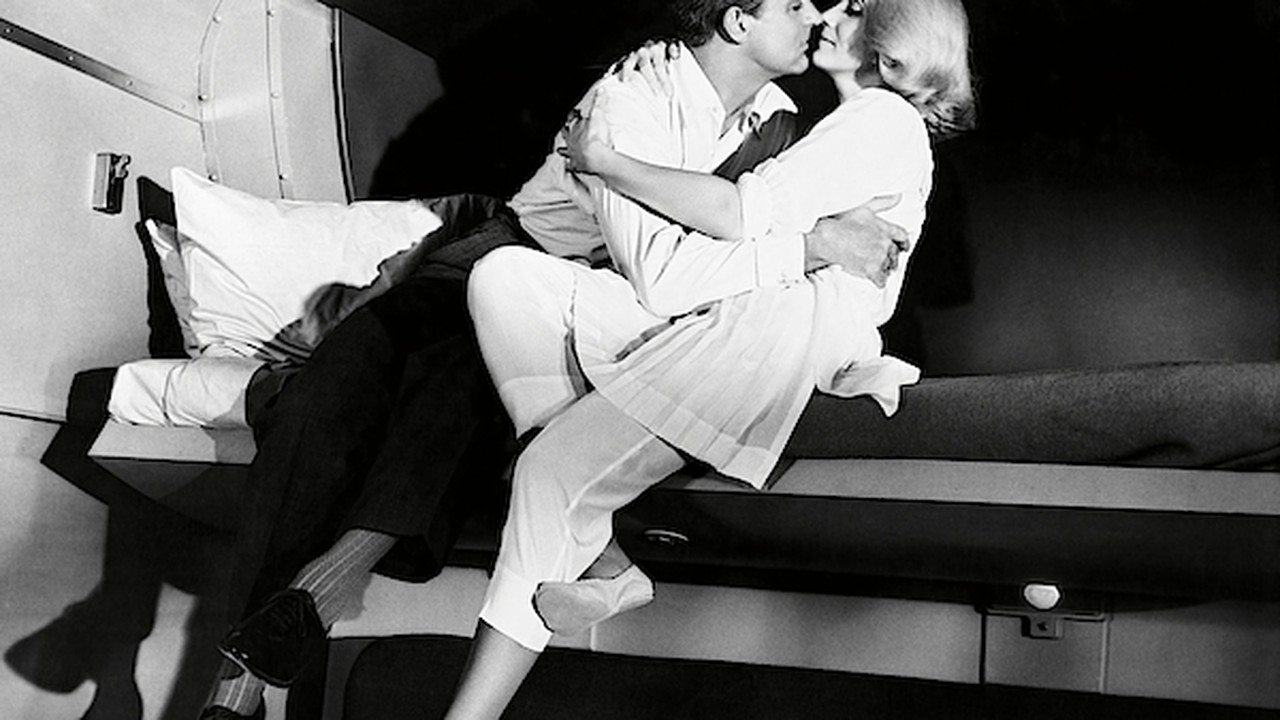
Five years later came her most memorable role — the cool double agent Eve Kendall, tasked with wooing Cary Grant, in Hitchcock’s 1959 thriller North by Northwest, one of the director’s signature films.
Her career spanned more than seven decades, including films like Exodus (1960) with Paul Newman, The Sandpiper (1965) with Elizabeth Taylor and Richard Burton, and Grand Prix (1966). She also won an Emmy and, at 93, received a standing ovation when she presented at the 2017 Oscars.
Saint was married to producer and director Jeffrey Hayden for 65 years until his death in 2016. They shared two children, son Darrell and daughter Laurette.
She was the oldest living Academy Award winner — and one of the final links to Hollywood’s golden age.
Kazan Picked Her Over Elizabeth Montgomery
Saint didn’t get the role of a lifetime by playing it safe. Director Elia Kazan cast her as Edie Doyle in “On the Waterfront” over Elizabeth Montgomery — the future star of “Bewitched” — after Saint screen-tested opposite Marlon Brando in a living-room audition crackling with chemistry. She was 30 years old playing a Catholic schoolgirl, but nobody in the audience cared. The film went on to win eight Academy Awards, including Best Picture, with Kazan named Best Director, Brando Best Actor and Saint Best Supporting Actress.
“The Sparks Flew”: The Living-Room Audition That Won Her the Oscar
Years later, in a 2000 interview with WHYY’s “Fresh Air,” Saint relived the audition that changed everything: “I don’t know what happened, but … [Brando] came in the living room. We were dancing, we were laughing, I was crying. He was taking my skirt and … whipping it around, and the sparks flew. And Kazan saw that. And suddenly I was in ‘On the Waterfront.’” She’d gotten on Kazan’s radar thanks to a legendary mentor — silent-screen great Lillian Gish, who co-starred with her in the 1953 Broadway production of “The Trip to Bountiful” that brought Saint to Kazan’s attention.
Hitchcock’s One Cold-Stare Rule
Five years after the chaste heroine Edie, she was playing the cool double agent Eve Kendall opposite Cary Grant — and Hitchcock gave her the strangest direction of her career. The director never discussed emotion with her at all, Saint recalled in a 2014 interview. Instead, he told her to lower her voice and “always, in my scenes with Cary Grant, look directly into his eyes, which was not difficult.”
Seven Decades, 161 Credits, Two Stars on the Boulevard
The rest of the résumé reads like a tour through classic Hollywood: Otto Preminger’s “Exodus,” John Frankenheimer’s “All Fall Down” with Warren Beatty and “Grand Prix” with James Garner, Vincente Minnelli’s “The Sandpiper,” and Norman Jewison’s Cold War satire “The Russians Are Coming, The Russians Are Coming” — an Oscar Best Picture nominee. In 1960 she became one of the few actresses honored with two stars on the Hollywood Walk of Fame — one for motion pictures, one for television. She won an Emmy in 1990 for the miniseries “People Like Us,” and in her 90s did voice work on the animated series “The Legend of Korra.” Her alma mater, Bowling Green State University, put her lifetime tally at more than 161 credits across stage and screens.
Through it all, she credited the discipline drilled into her at the Actors Studio by Lee Strasberg, who taught her to think of her body as “an instrument, a musical instrument”: “So take care of your body. You have to be disciplined and you should be able to play what that director wants.” With her gone, Hollywood loses one of its final living links to the golden age.